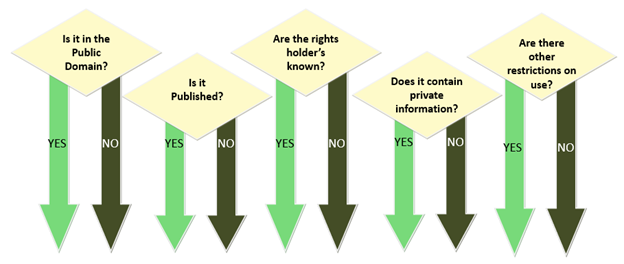
Reviewing materials from special and archival collections with the intention to digitize them for wider public access requires more than just determining if something is in the public domain. There are several questions that are answered in the collection review process and several layers of rights that must be considered.
Publication
When exploring the rights associated with archival materials and library special collections, determining whether a resource has been published is a crucial first step. Copyright law draws a distinction between published and unpublished works. Before the copyright law reforms of the late 1970s, unpublished works were granted a different and often longer term of copyright protection compared to published works.
Traditionally, the right to publish has belonged to the author. Only the author can decide when and how their work becomes public. Once a work is published, it creates a “version of record” and helps clarify who holds which rights. The publication process also often involves securing permissions for using content created by others or that contain private and potentially privileged information, ensuring that all legal and ethical considerations are addressed before making the work available to a wider audience.
Contractual Obligations
Contractual obligations play a significant role in determining how archival materials can be accessed and reused. Donors may impose specific restrictions through agreements that dictate the permitted uses of their collections, impacting who can view or utilize the materials.
Publication contracts can also come into play when examining different drafts of an article or book within the archives. These contracts may include a transfer of copyright to the publisher, affecting the rights associated with both published and unpublished versions. While separate copyright protections might apply to various drafts and editions, publishers typically have a vested interest in drafts that closely resemble the final published work. As a result, contractual terms can shape not only access but also the ability to reuse archival materials, making it essential to review these agreements when managing rights in special collections.
Copyright & Co-authorship
Archival materials often involve multiple layers of rights due to the presence of various authors and contributors. For example, oral histories are typically co-created by both the interviewer and the interviewee, and each may hold rights to their respective contributions if both are featured in the recording or transcript. Oral history best practices and interviewee release forms have been developed specifically to help oral history researchers manage the rights and interests for eventual reuse and publication of the resulting research.
Similarly, newsletters and local newspapers are often collaborative efforts. Without formal agreements transferring copyright, there can be ambiguity about who owns which rights. The entire newspaper as a compilation may be under the copyright of the publisher, while individual articles contributed by outside writers are usually owned by those contributors. These overlapping rights and instances of co-authorship can complicate access and reuse, making it essential to carefully consider and identify all potential rights holders before repurposing archival sources.
Privacy, Confidentiality, and Legal Restrictions in Archives
Archival sources might contain materials and information that would be protected by state or federal privacy laws. This means that certain documents like personal correspondence, medical records, school transcripts, or even oral histories can be subject to restrictions governed by privacy regulations and confidentiality agreements. These protections are designed not only to safeguard sensitive information but also to uphold the rights of individuals whose data appears in archival collections.
Among the most significant laws affecting archival access and use are the Family Educational Rights and Privacy Act (FERPA) and the Health Insurance Portability and Accountability Act (HIPAA). FERPA regulates the disclosure of educational records, ensuring that student information remains confidential unless proper consent is given. For archivists, this means that student files, grade reports, and other school records cannot always be made freely available.
Likewise, HIPAA protects health information, requiring that any records containing medical or health-related data be handled with strict confidentiality. Archives that hold medical files, provider correspondence, or research studies involving patients must ensure that access is limited to prevent unauthorized disclosure.
Some collections may include sensitive personal narratives, unpublished manuscripts, or business records that require special consideration. Archivists must balance the need for access with the obligation to protect privacy, which can mean restricting parts of a collection, requiring permission for use, or even withholding certain materials entirely.
Traditional Knowledge
Traditional knowledge refers to the cultural, spiritual, and intellectual heritage developed and maintained by indigenous communities and other cultural groups over generations. Unique layers of rights must be considered by archives acquiring materials containing traditional knowledge. These rights often go beyond standard copyright law and contractual obligations, requiring the consideration of community stewardship, customary law, and recommended protocols for use.
Specific collections may include sacred stories, ceremonial practices, or community histories captured in manuscripts, oral histories, and photographs for which access and reuse are governed by the originating community’s values and permissions. Archivists must recognize that the rights holders may not be individual authors, but rather the entire community or tribe. In some cases, legal frameworks and international agreements, such as the United Nations Declaration on the Rights of Indigenous Peoples, support the protection of traditional knowledge, emphasizing the need for obtaining free, prior, and informed consent before sharing or repurposing these materials.