I spent a good deal of my childhood summers with my grandmother, either in her garden or in her kitchen. I am not really sure if she enjoyed baking and cooking. I suspect that, for her, baking for her large family was just something that one did. My grandmother was the type of baker to measure ingredients with fingers and fists, so I am often prone to do the same.
My mother had this same measuring style to a smaller extent, and she tended to save her baking sprees for holidays. Holiday baking is also where I started baking on my own. I inherited the recipes of both my grandmother and my mother. Except for one recipe. The recipe I most missed the taste of, my mother’s fruitcake, was missing. It is possible that it is the one recipe written in shorthand, something I can’t read. Maybe it is the bookmarked fruitcake recipe in her 1970s copy of the Better Homes and Gardens cookbook, only with alterations that only she knew.
My quest to find or emulate my mother’s fruitcake recipe has resulted in a deep dive into fruitcake history, a growing collection of old recipe pamphlets, and a fascination with how corporations taught Americans how to eat. You won’t find the fruitcake recipe in it, but if you were interested in U.S. food history, I recommend How Corporations Taught Us to Love Bananas, Spam, and Jell-O by Christia Ward.
THE COOKBOOK

The USF Libraries’ 1864 printing of American Kitchen, Directory and Housewife by Ann Howe is a later edition of a popular book first published as American Housewife in 1839. It was expanded with The Kitchen Directory and finally published under the title that we have today. The author’s name did not appear on the title page until later editions of the book (eBooks.com, n.d.).
The preface of each consecutive edition allowed Ann Howe to explain her hope that her book addresses the lack of cookbooks with practical knowledge of cooking to accompany the collection of recipes, or “receipts” as it is written in the book (HathiTrust). Beyond her frank addresses to the reader, I could find very little else about Ann Howe.
THE RECIPE
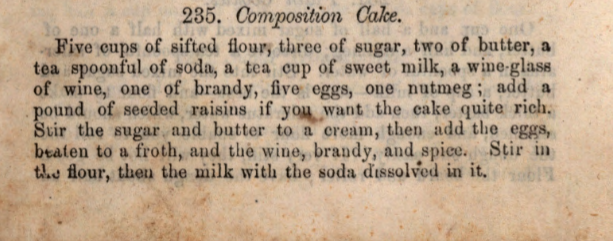
The recipe for “Composition Cake” as it is written in the clipping above requires “five cups of shifted flour, three of sugar, two of butter, a tea spoonful of soda, a tea cup of sweet milk, a wine-glass of wine, one of brandy, five eggs, one nutmeg; add a point of seeded raising if you want the cake quite rich.”
Whenever I see a recipe with something like 5 eggs, I scale it down. Older recipes often produce a substantial amount of baked goods, making it more practical to reduce the recipe size. Since it is difficult to divide raw eggs, my recipe adjustment is based on the number of whole eggs.
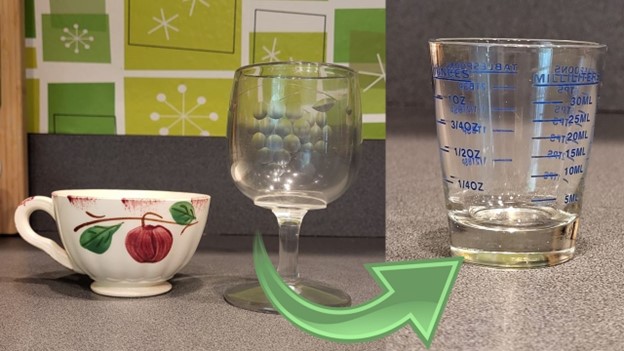
But what about that teacup full of sweet milk and a wine glass each of wine and brandy? The size of cups and glasses has fluctuated drastically over time. Even the 1940s teacup and 1900s wine glass I have from my grandmother and great grandmother respectively are probably not the right sizes.
Luckily the internet can help us trace what the measurements actually meant. A teacup unit of measurement in the UK = 5 British imperial fluid ounces (Wikipedia) and a wine glass equals 2 British imperial fluid ounces. Of course, British imperial fluid ounces are different than US customary fluid ounce, so we will have to find that conversion as well.
| British Imperial fluid ounce | US Customary fluid ounce |
| 5 | 4.803799 |
| 2 | 1.92152 |
I have to make a confession here: I don’t weigh my ingredients, I barely sift my flours, and half the time I don’t closely follow most recipes so the difference in a British Imperial to US Customary ounce measurement for this recipe is not enough for me to factor in. I would’ve just rounded up anyway. That said, what is only a slight variation in size for this recipe, cut down to 3/5 of its original measurements, could be a large variation if doing a recipe for eggnog, for example, that called for six wine glasses of brandy, so it is always good to check.
My updated measurements for this recipe are:
- 3 cups flour
- 1.8 cups sugar
- 1.2 cups butter (softened)
- Large half tsp baking soda
- 3 eggs
- Large half tsp nutmeg
- Half a pound of raisins (I used a half and half mix with Xanthe currants)
- 3 ounces (or 88.72059 milliliters) of sweet milk
- 1.2 ounces (or 35.48824) each wine and brandy
Wine and brandy are relatively the same as they would’ve been 160 years ago, but what is ‘sweet milk?’ The answer is somewhat disappointing. Sweet milk simply refers to ‘whole milk’ (Williams, 2021).
Old recipes often require reading instructions first, or you risk doing it wrong. This one needs you to read general directions related to that type of bake which are located at the start of each section, pages before the recipe itself. I didn’t do this; I only printed the recipe to work out my math for baking. I guessed most of the method because I’ve made many old fruit cakes trying to replicate my mother’s recipe (unsuccessfully so far).
With the general instructions, the recipe itself provides a basic order for combining the ingredients but does not specify what is meant by ‘stir in’ when adding the butter and sugar or flour. It also lacks details on preparing a pan, specifying a pan shape, indicating stove temperature, or stating how long the cake should bake. While modern temperature control ovens were not available in 1860, older cookbooks typically provide some guidance, such as referring to a hot stove, high heat, or slow cooking. The instructions that preface the section on ‘sweet cakes’ mention only that a “rich cake with fruit bakes best in a brick oven” and that the pans should be buttered and well lined.
We are also instructed to beat the yolks and whites separately prior to adding to a recipe (I did not do this), and that all ingredients should be at room temperature (my wording). In reading the instructions in The American Kitchen I am reminded that a lot of the preparation home cooks had to undergo in 1860 is taken care of for us: I didn’t need to seed my raisins, the Xanthe currants I have are already washed and dried, the sugar is already flaked finely and not in a hard cone.
THE METHOD
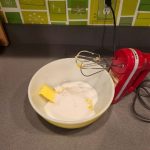
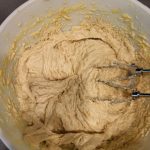
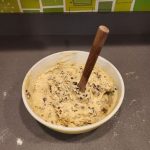
- To start, I beat the softened butter and sugar together until they were well mixed.
- I then added the eggs and beat until the entire mixture was fluffy and light. I think my electric mixer was better at beating in air than my arms would’ve been, so I didn’t end up feeling too bad about having ignored the instruction for separating the yolks and whites.
- Next, I added nutmeg, wine, and brandy. The mixture did curdle because of the alcohol, but a little extra beating and the consistency smoothed out for the most part. I wasn’t worried about it. Curdled cake batter usually just means a less fluffy cake. I already could tell this was destined to be dense from the ingredients.
- The baking soda had been dissolved in the milk. I alternated mixing in flour and milk to the mixture. At about halfway through, it was time to swap out the hand mixer for a sturdy wooden spoon. This is a must for all fruitcakes, and something that I feel compelled to elaborate on for anyone who has not made a lot of fruitcakes. Fruit cakes will eat the heads off your spatulas if there is a seam where the handle connects. Fruit cakes will break the dainty handles of elegant wooden spoons. While sitting cross-legged on the floor with a mixing bowl in my lap just to get enough leverage to turn a fruitcake batter, I have had both of these things happen to me.
- Finally, it is time to add the fruit. By the end of mixing, your sturdy wooden spoon should stand up in the batter.
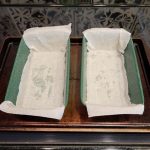
- I dolloped the batter into two buttered and lined bread pans. Notice, I nearly halved the recipe and still had enough batter for two loaf cakes. These are the kind of pans I would suggest using for fruitcake in order to get the middle cooked before the outside gets too dry. The batter’s thickness required quite a bit of coaxing to get it in the corners and spread relatively evenly in the pan.
- I put them in the oven at 350 F for 40 minutes, then turned it down to 325 F for another 40 minutes. I hemmed and hawed over the initial temperature and baking time. Recently, I had baked a fruit cake with similar ingredients at 350°F for 45 minutes, although most of the fruitcakes I have made follow a low and slow approach. I decided that if it was not nearly done after 40 minutes, I would lower the temperature and extend the duration. As this was indeed the case, should I bake this again, I would likely start at 325°F for approximately an hour and 45 minutes.
THE BAKE
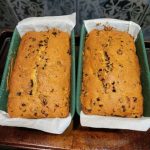
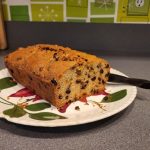
The results were very good! The cake was predictably dense with even fruit distribution. The wine and brandy were not at all prominent flavors, though I am sure they added to the richness of the cake. The sugar content in the batter made for a pleasingly crisp exterior, but the cake is not terribly sweet, which is just to my taste. This is an excellent cake for toasting with butter as a breakfast loaf.
Want to read more posts like this one?
Explore our Baking the Archives series!
References
Williams, C. (2021) What Is Sweet Milk — And Why Is It In So Many of My Grandma’s Recipes? All Recipes. https://www.allrecipes.com/article/what-is-sweet-milk/
EBooks.com (n.d.) The Kitchen Directory, And American Housewife. https://www.ebooks.com/en-us/book/211171279/the-kitchen-directory-and-american-housewife/antiquarian-collection-cookbook/