Post by Amanda Boczar, Associate Director, USF Libraries’ Digital Initiatives unit
In a world where so little of our knowledge creation is done with pen and paper, how are libraries and archives preserving the history of today? That question is top-of-mind for many curators, librarians, and archivists who are seeing a rapid increase in donations of digital files and a wide range of media formats. Proactive planning and skill development can help manage the growth of what archives refer to as born-digital collections.
The Born-Digital Archives Toolkit, was created to support professionals and donors through the process of preparing, accepting, and making accessible these exciting collections. After working with a variety of donors and collection types, Sydney Jordan, Coordinator for the FLENH Archives in Special Collections, and I thought a one-stop guide would be helpful to those at USF and beyond. The toolkit offers a look at the benefits, like transferring a lot of information on a small device, and the drawbacks, like receiving excessive duplication or copyrighted materials, of these transfers.
Often, when donating materials to a library archive, it is far easier to donate large amounts of unrelated materials when they are nested within digital folder structures than it is to hand over that same volume of physical papers. It is also easier to accidentally share materials with private and personal information when it is saved on a hard drive. For example, a downloaded copy of your tax or bank records may have a random string of numbers that’s not as easy to spot as a W2 would be if you were sifting through your personal papers in a box.
To help mitigate these challenges and better open the door for the opportunity to receive large collections of valuable research data, the toolkit offers checklists, sample questionnaires to work through with donors (or by yourself if you hope to donate your own materials), and sample workflows and donation documents to help ensure the smoothest possible process. Each of these items are adaptable and flexible to suit the size of the institution working with the materials.
Wondering what born-digital collections look like at USF? Here are a few examples to browse:
The Karst Information Portal is an open-access digital library linking scientists, managers, and explorers to quality information resources in order to inform research, to enhance collaboration, and to address policy decisions concerning karst environments.
Selected records from the Audubon Florida’s Corkscrew Swamp Sanctuary, a site which had been protected by Audubon wardens since the 1910s. Audubon Florida founded the sanctuary in the mid-1950s. From an initial 5,000 acres, it was expanded to more than 13,000 acres. This portion of the collection will have videos donated as part of Corkscrew Sanctuary’s archive.
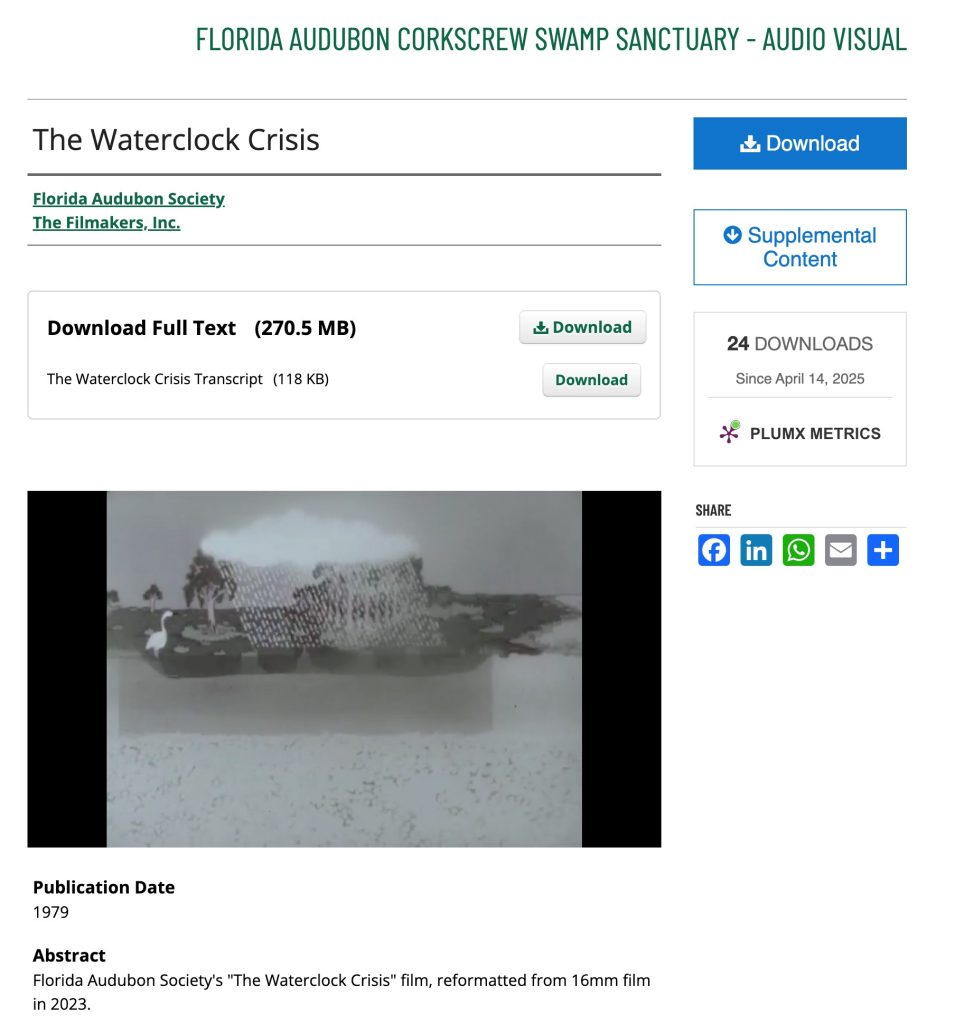
The Waterclock Crisis video, transferred from deteriorating 16mm film, is embedded in the USF Digital Commons repository.
IDEx, created and run by Dr. Davide Tanasi, upholds its mission to contribute to the development of digital scholarship and popularize the humanities and social sciences among the student population and global community by tackling major themes in the field such as virtual accessibility, digital preservation, memory in the digital age and digitally enhanced cognition. The Institute applies 3D digital techniques and visualization for the documentation, analysis, interpretation, and online dissemination of global cultural heritage sites and historical and archaeological collections, emphasizing those that are endangered, inaccessible, or underrepresented.
USF Libraries collects and conducts born-digital oral history interviews to maintain in the archives. This meta-collection page provides a launching pad into several oral history collections directly related to the history of the university.