This post was guest authored by Mikayla Osso, Collections Operations Supervisor in Collections & Discovery at the Tampa Library
When I was a little girl, there were two toys that I wanted more than anything: a Baby Alive doll and an Easy Bake Oven. Unfortunately –or perhaps fortunately in the end –I received neither. Instead, my mom gave me a baby brother and a lesson in how to use the real oven. From there on out I became an excellent big sister and an avid baker.
Baking became a true passion of mine and for many years I wanted to become a pastry chef. I would spend hours watching baking shows on the Food Network and dreaming of a life making croquembouches. Although those dreams did not come to fruition, my love of baking has never waned. I still happily bake for my friends and family. Whenever people come to my house there is always the chance of enjoying a freshly baked treat!
THE COOKBOOK
To be completely transparent, there was no rhyme or reason in my selection of what cookbook to use for this blog post. I knew I wanted to make a cake of some sort when looking for a recipe. I have never been a great lover of pies, and I wasn’t sold on making muffins or biscuits. So, I skimmed through all the cake sections of the various cookbooks until I decided to pick the White House Cook Book: A Selection of Choice Recipes Original and Selected, During a Period of Forty Years’ Practical Housekeeping (1889) by Fanny L. Gillette. Mrs. Fanny Gilette is in fact the mother of King Camp Gillette, inventor of the Gilette safety razor.
I enjoyed reading the preface of the book. Gilette states that she wrote this book at the “urgent request of friends and relatives”. Humble. She also mentions that the book will not close in on itself when open. I wish modern cookbooks adopted this technique –that told me Mrs. Gilette used cookbooks frequently and took the time to include this detail to make things even a little easier for the homemakers of her time.

THE RECIPE
I landed on two cake recipes from the White House Cook Book, a coconut cake and a soft ginger cake. I had my mother decide between the two because I was deadlocked! Unsurprisingly, she chose the soft ginger cake (my mom loves anything ginger). I’ve made other ginger recipes before, gingerbread, ginger snaps, etc., so this seemed right up my alley!

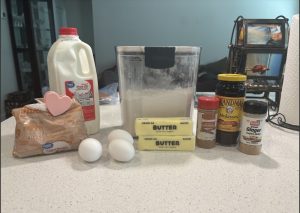
Everything seemed rather standard, like butter, brown sugar, eggs, etc. The only thing that stood out to me was the amount of molasses required… “two cupfuls”. For those that don’t regularly make ginger bakes, that is a lot of molasses. The only spices in the cake were cinnamon and ginger, but to me a ginger bake is usually heavily spiced with nutmeg, cloves, and much more than a teaspoon of cinnamon. However, I reminded myself that I was looking at this recipe through modern eyes. I had to trust the bakers from 1889 and their 40 years of practical housekeeping.
THE BAKE
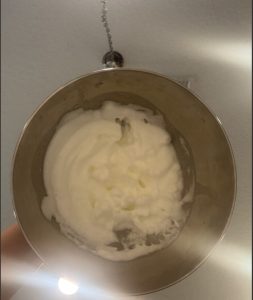
This cake did not require a lot of ingredients, and the instructions were straightforward. However, for probably the first time in my life I read the recipe headnotes. Recipe headnotes are the text before a recipe where the author gives details about the bake itself or what inspired the recipe. In the White House Cook Book, the headnotes were at the beginning of each section and gave some important general knowledge about the bakes in said section. I was glad I read the headnotes because I learned that the egg whites were meant to be whipped into a stiff froth and the yolks into a thick cream. The recipe didn’t specify this, only that the whites and yolk were to be beaten separately.
Here are my whipped egg whites. I took a photo of the bowl upside down, Dairy Queen Blizzard style, to show off my stiff froth.
As an aside, I am a stand mixer girly. I use my stand mixer for everything. However, the stand mixer was not invented until 1908. Instead, I opted to use my electric hand mixer, which was invented in 1885. I creamed my butter and sugar, then combined it with the milk, spices and eggs.
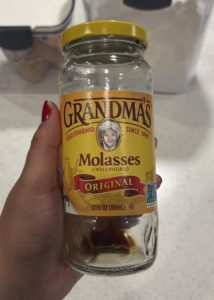
Now came the issue of the molasses. I debated on whether to follow the exact recipe and put 2 cupfuls of molasses in my batter. But the matter was decided for me, my jar of molasses only gave me 1 ½ cups. I squeezed every drop out of the jar and figured the baking gods had done me a favor.
My batter was a curdled chunky mess at this point, and I was having serious doubts. But, after adding 4 cupfuls of flour, the batter became smooth and yummy looking.
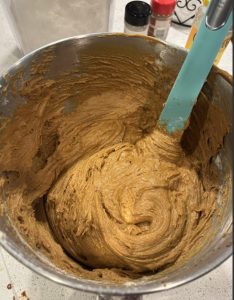
However, there was one serious problem, the batter was only yummy looking. It tasted like I ate a spoonful of molasses straight out of the jar. My assumptions about the amount of molasses in this recipe were proven correct and I was faced with a serious dilemma: Do I leave the recipe as is? Or do I tweak it? … Of course, I chose to tweak the recipe. There was no way I was going to bake a cake with a batter that tasted so bad. I added more spices, more cinnamon and ginger, a little nutmeg and some pumpkin pie spice. This improved things significantly. The molasses taste was still strong but had been subdued. I hoped that once it baked the flavor would mellow out a bit more.

The recipe called for two bread pans, but I only had one. Frankly, I wasn’t sure that I wanted to have two of these cakes anyway. I baked the cake in a moderate oven (350 degrees) and it took about an hour to bake fully.
The top did crack open, but the inside was still nice and soft.

Thankfully, the molasses cooked out a bit more over the course of the bake. The overall flavor was okay, although my mom still thought it was too molasses-y for her tastes. The other issue I had with this bake was that the further I cut into the loaf the rawer the inside was. That was very disappointing, and I seriously considered chucking the thing into the woods behind my house. A colony of ants would find more use for this cake than my family.
The experience of baking a vintage recipe was a good one. It allowed me to see how people cooked in the past and let me test my own knowledge as a baker. Unfortunately, I will not be making the White House Cook Books’s “Soft Ginger Cake” again. I’m sorry to say to Mrs. Fanny Gillette, but her cake was not “most excellent” to me.
Explore more historic recipes:
- USF Libraries Digital Collections’ Historic Cookbook Collection
Want to read more posts like this one?
Explore our Baking the Archives series!
References
Fanny Lemira Camp Gillette (1828-1926) – find a… Find a Grave. (n.d.). https://www.findagrave.com/memorial/111219262/fanny-lemira-gillette
Persaud, C. (2023, February 9). A brief history of mixers. Best Buy Blog. https://blog.bestbuy.ca/appliances/small-appliances/history-of-mixers